Published by Rims & Tires
Compiled & checked by the site's publisher from manufacturer, NHTSA & USTMA data · Updated 2026-07-24
All-terrain (A/T) and mud-terrain (M/T) tires are the two main categories for off-road capable truck tires. Choosing between them is the most common question West Georgia truck and Jeep owners ask when upgrading. The right choice depends on how you actually use the truck — not how you want to use it.
Tread Design and Off-Road Performance
All-terrain tires run an intermediate tread pattern. The voids are wider than a highway tire but nowhere near as open as a mud-terrain. That middle ground clears mud and debris while keeping enough rubber on the road for decent pavement manners. Most A/T tires are built for an 80-20 or 70-30 on/off-road split.
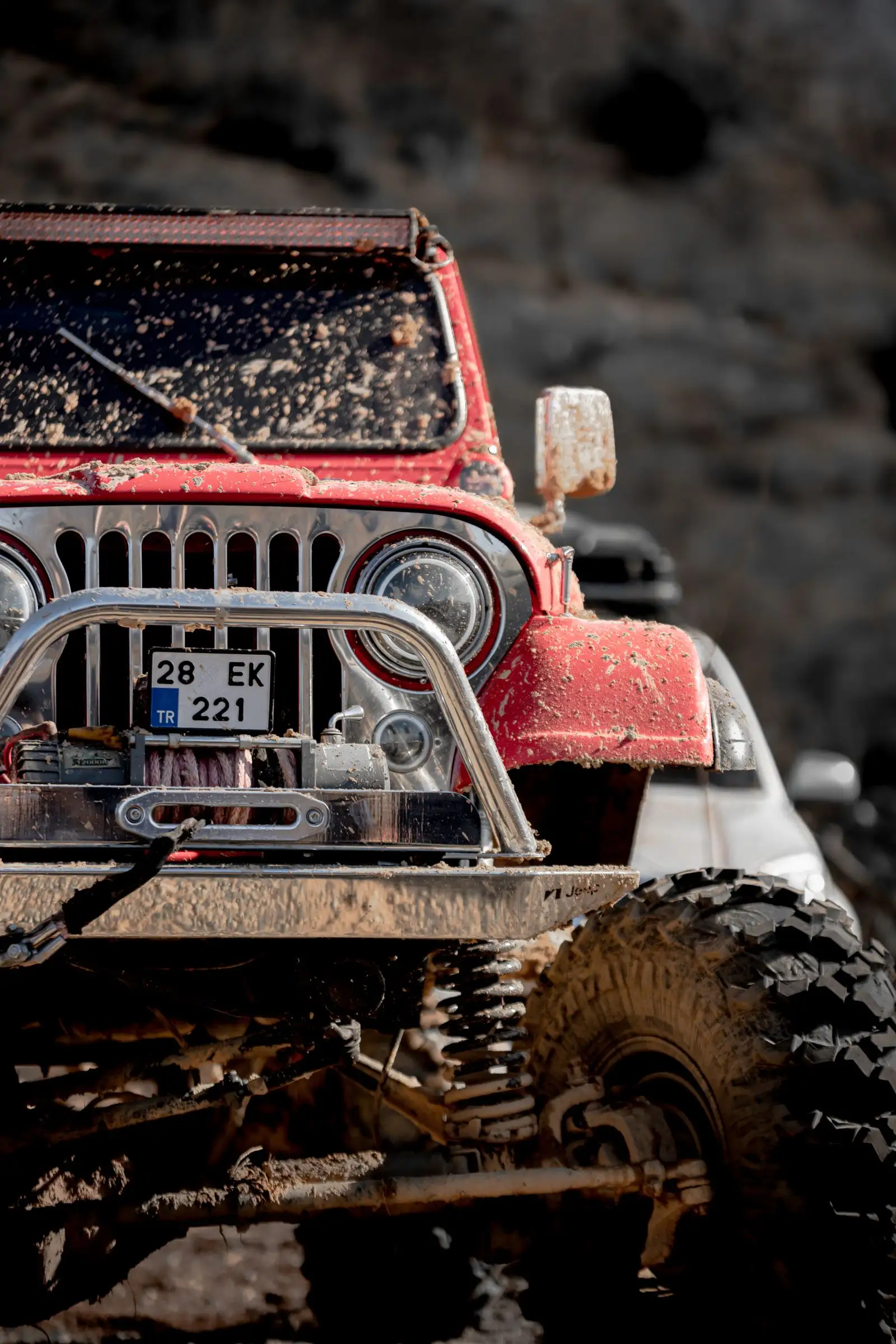
Mud-terrain tires have large, widely spaced lugs with deep voids specifically designed to self-clean in thick mud and loose dirt. The wide voids allow the tire to dig and paddle out of mud that would pack and render an A/T ineffective. M/T tires excel in mud, rock, and soft off-road terrain.
In dry dirt, sand, and moderate trails, both A/T and M/T perform well. The A/T's advantage is its highway manners; the M/T's advantage is in deep mud and rocky technical terrain.
In snow: most A/T tires (especially 3PMSF-rated ones) outperform M/T tires because the A/T's intermediate tread bites snow more consistently. M/T's large open voids pack with snow inefficiently.
Highway Performance and Daily Driving
Highway noise: A/T tires are much quieter than M/T tires on pavement. The big lugs and open voids of a mud-terrain create a steady thumping, humming sound at speed, and it is louder than most people expect before they buy. A/T tires run from near-passenger-quiet, like the BFG KO2, to moderately loud.
Tread life: A/T tires last longer than M/T tires on pavement because they have more rubber in contact with the road. Typical A/T highway tread life: 50,000 to 70,000 miles. M/T tires on pavement: 30,000 to 45,000 miles.
Fuel economy: M/T tires increase fuel consumption by 1-2+ mpg compared to A/T because of higher rolling resistance from the aggressive tread. On a daily-driven truck doing 15,000 miles per year, this is a real cost.
Wet pavement: A/T tires handle wet pavement significantly better than M/T tires. M/T's large open voids reduce the rubber contact patch on wet roads, increasing stopping distance.
West Georgia Local
Find the right shop near you
Tell us your vehicle and what you need — we'll match you with a vetted West Georgia shop. Free, no obligation.
The Right Choice for West Georgia
If your truck is daily-driven but you want off-road capability: all-terrain tires. You spend better than 90 percent of your miles on pavement, and the A/T gives you the look and real capability without the noise and fuel penalty.
If you regularly drive in deep mud (rural roads after rain, hunting land, construction sites): mud-terrain makes sense. West Georgia's clay soil packs into A/T voids quickly; M/T tires self-clean in this soil type.
If you do serious rock crawling or off-road events: mud-terrain is the standard for technical off-road use.
For the daily driver that occasionally goes mudding: BFG KO2, Falken Wildpeak A/T3W, or Nitto Ridge Grappler (hybrid A/T) are the most common balanced choices.
All-terrain vs. mud-terrain tires at a glance
| Factor | All-terrain (A/T) | Mud-terrain (M/T) |
|---|---|---|
| Best terrain | Road plus light to moderate trail | Deep mud, rock, technical off-road |
| Highway noise | Low to moderate | Loud; thumps and hums at speed |
| Tread life on pavement | 50,000 to 70,000 mi | 30,000 to 45,000 mi |
| Fuel economy | Better | About 1 to 2+ mpg worse |
| Wet pavement | Better grip, shorter stops | Reduced contact, longer stops |
| Snow | Good, especially 3PMSF A/T | Weaker; open voids pack with snow |
Frequently asked
Are mud-terrain tires worth it for daily driving?
For most daily drivers: no. The highway noise, reduced wet-weather grip, and fuel economy penalty are real downsides. A/T tires provide the off-road look with far better pavement manners. M/T is worth it when you regularly encounter conditions where an A/T would fail.
What are the quietest mud-terrain tires?
No M/T tire is quiet. The least loud options are the BFGoodrich KM3 and the Falken Wildpeak M/T01 — both are noticeably quieter than older M/T designs, but still louder than any A/T tire.
Can I mix A/T and M/T tires on the same truck?
Not recommended. Different tread compounds and tread patterns across axles cause uneven handling behavior. All four tires should match brand and type for consistent traction across all conditions.
Which lasts longer, all-terrain or mud-terrain?
All-terrain, by a good margin on pavement. More rubber meets the road, so the wear is slower and the tread life runs longer than a mud-terrain doing the same daily miles. If most of your driving is paved, the A/T stretches your money further before it needs replacing.
Which should I buy for a truck that mostly sees West Georgia roads?
For most folks around here, an all-terrain is the smarter pick. You spend the vast majority of your miles on pavement, and a good A/T handles our rain, the occasional job site, and red-clay back roads without the noise and fuel penalty of a mud-terrain. Save the M/T for a truck that genuinely lives in deep mud or on the rocks.
Keep reading
Last updated 2026-07-24. General guidance only — confirm specifics with a local shop for your exact vehicle.