Published by Rims & Tires
Compiled & checked by the site's publisher from manufacturer, NHTSA & USTMA data · Updated 2026-07-24
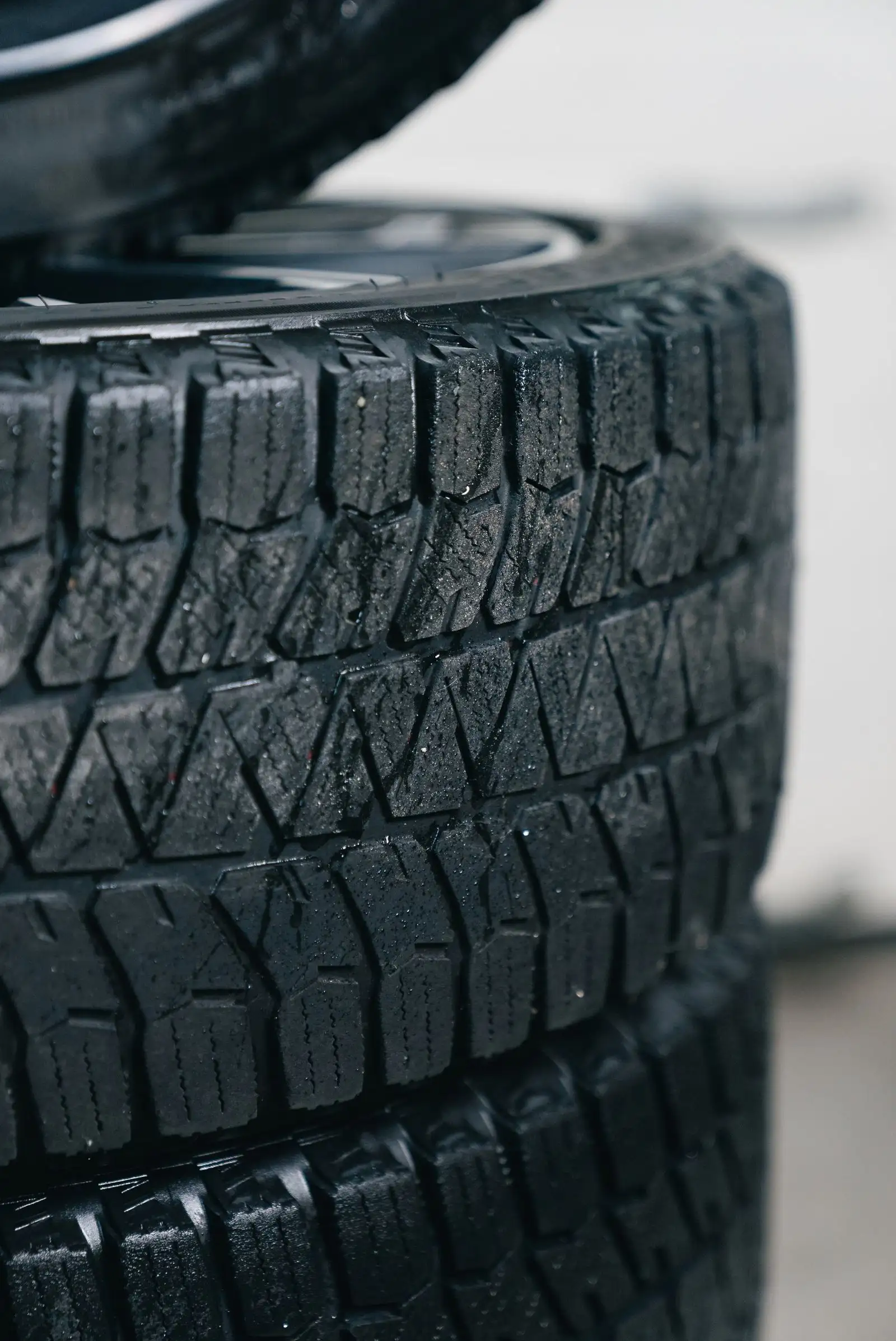
Tire tread pattern is not just about looks. It determines how water is channeled away from the contact patch, how the tire grips in corners, and how it must be mounted. Understanding the pattern type helps you choose the right tire and install it correctly.
Symmetric tread pattern
The most common pattern for budget and mid-range tires. The tread pattern is identical on both halves of the tire: inside and outside, left rotation and right rotation are the same.
Can be mounted in any direction: no inside/outside designation, no rotation direction. The most flexible mounting option.
Trade-offs: good all-around performance but optimized for neither wet channeling nor dry cornering in the way that asymmetric and directional patterns are.
Asymmetric tread pattern
An asymmetric tire has a different tread design on the inside half vs. the outside half. The inside half is optimized for wet channeling (larger grooves). The outside half is optimized for dry cornering (larger tread blocks for grip).
Must be mounted correctly: the sidewall is marked "INSIDE" and "OUTSIDE." Installing backwards eliminates the design advantages of both halves.
Most premium all-season and performance tires use asymmetric patterns — the inside/outside division allows optimization for both wet safety and dry grip.
West Georgia Local
Find the right shop near you
Tell us your vehicle and what you need — we'll match you with a vetted West Georgia shop. Free, no obligation.
Directional tread pattern
Directional tires have a V-shaped or arrow-shaped tread pattern that is designed to rotate in one direction only. The pattern is most effective at channeling water when rolling forward in the designed direction.
Must be mounted correctly: an arrow on the sidewall shows the direction of forward rotation. A backwards directional tire loses most of its water-channeling advantage.
Can only be rotated front-to-back on the same side: no left/right swapping without demounting and remounting. This limits rotation patterns and adds cost to the rotation service.
Common on: winter tires, high-performance summer tires, and some all-terrain tires that emphasize mud or water clearance.
Frequently asked
What happens if a directional tire is mounted backwards?
The water-channeling grooves run the wrong way. Instead of directing water toward the edges, they collect water under the contact patch. The result is significantly reduced wet traction and hydroplaning resistance. This is why tire mounting direction is a safety issue, not just a performance preference.
What does IN and OUT mean on a tire?
IN and OUT indicate the inside and outside faces of an asymmetric tire. The outside face (marked OUT) should always face outward away from the vehicle. Installing an asymmetric tire backwards ruins its tread design performance.
Can I change from directional to non-directional tires?
Yes — directional and non-directional tires of the same size are interchangeable. Switching to non-directional tires gives you more rotation pattern flexibility. The choice should be based on which tire model performs best for your needs — not just the mounting flexibility.
Does tread pattern really affect how a tire performs in the rain?
It does. The grooves and channels are what push water out from under the tire so the rubber can still grip the road, so a pattern with good water evacuation resists hydroplaning better. That matters in West Georgia's summer downpours, where standing water builds fast. Compound and tread depth play a role too, but the pattern is doing a lot of the work in the wet.
Which tread pattern is best for my car?
For most daily drivers, an asymmetric all-season hits the sweet spot with solid wet grip on the inner half and dependable dry cornering on the outer. Directional patterns tend to show up on winter and performance tires where clearing water or snow is the priority. Rather than chase a pattern type, pick the tire model that tests well for how you drive, and the pattern follows from that.
Keep reading
Last updated 2026-07-24. General guidance only — confirm specifics with a local shop for your exact vehicle.