Published by Rims & Tires
Compiled & checked by the site's publisher from manufacturer, NHTSA & USTMA data · Updated 2026-08-01
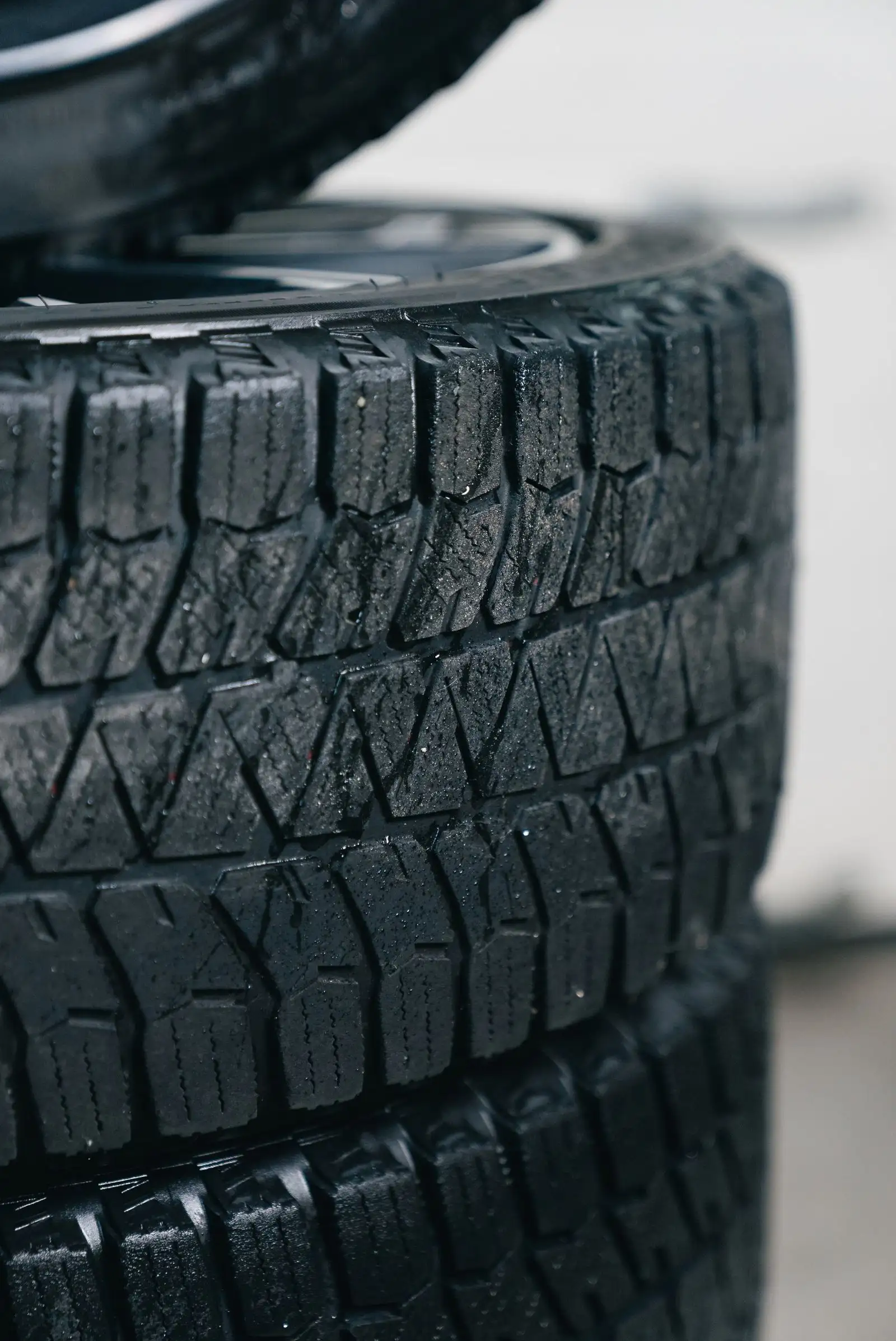
Replace tires when tread hits 4/32", when they pass six years old regardless of tread, or when you find a sidewall bulge, severe uneven wear, a vibration that survives rebalancing, deep sidewall cracking, or a second puncture in the same tire. Any one of those is reason enough. Tires warn you well before they fail, and acting early is both safer and cheaper.
Is the tread at 4/32" or below?
The legal minimum is 2/32", but safety degrades noticeably below 4/32" on wet roads. Wet weather stopping distances at 2/32" can be 40–50% longer than on new tires.
Use the quarter test: insert a quarter with Washington's head pointing in. If you can see the top of his head, you're at or below 4/32" and should plan replacement. If you can see above his head, replace immediately.
Are the tires more than six years old?
Tire rubber oxidizes and hardens over time, regardless of how much tread remains. A six-year-old tire with decent tread depth can still be structurally compromised.
Check the DOT date code on the sidewall. The last four digits are the week and year of manufacture. Tires over 6 years old should be replaced; at 10 years, replacement is mandatory regardless of appearance.
West Georgia Local
Find the right shop near you
Tell us your vehicle and what you need — we'll match you with a vetted West Georgia shop. Free, no obligation.
Is there a bulge or bubble in the sidewall?
A bulge or bubble on the sidewall means the internal cords are broken and the tire is in structural failure. This is a replace-immediately situation. Do not drive at highway speed on a tire with a sidewall bulge.
Is the wear noticeably uneven?
One side of the tread wearing faster than the other (edge wear) indicates alignment is off. Center wear means chronic overinflation. Patchy or cupped wear indicates balance or suspension issues.
Replace tires with severe uneven wear and fix the underlying cause, otherwise the same thing happens to the new set.
Does a vibration persist after balancing?
Vibration that does not go away after re-balancing is a sign of internal tire damage — a shifted belt, a force variation, or a tire that is running out of round. These conditions do not fix themselves.
Is the sidewall cracking?
Small surface cracks are cosmetic on newer tires. Deep cracking, extensive spider-web cracking, or cracking on tires over 5 years old indicates dry rot: the rubber compound has degraded. Replace before the cracks become a failure point.
Has the same tire gone flat twice?
A tire that has been repaired once and then gets another puncture nearby, or a tire that keeps losing air without an obvious cause, is telling you something. Repeated repair in the same area weakens the structure. A slow leak from the bead or valve stem may be repairable; chronic deflation from internal liner damage usually means replacement.
Frequently asked
How do I know if my tires are too old?
Check the DOT date code on the sidewall. The last four digits tell you the week and year (for example, 1523 means week 15 of 2023). Tires over 6 years old should be inspected by a professional and replaced if any concerns are found. At 10 years, replace regardless.
Should I replace all four tires at once?
The U.S. Tire Manufacturers Association recommends replacing all four at the same time for optimal performance, and matching tires on all four corners does give the most predictable handling. In practice, replacing two at a time is common for budget reasons. USTMA's rule for that case: install the two new tires on the rear axle. Deeper tread on the back is what prevents oversteer on a wet road.
How much does it cost to replace four tires?
For a typical passenger car or truck, a full set of four quality tires runs $400–800 installed. Budget tires can be $250–400; premium brands $800–1,500+. West Georgia shops across Carroll, Douglas, and Paulding counties offer a range of options, so get a free quote to compare.
Can I replace just one tire?
Yes, in most situations. If the other three are reasonably matched in brand, model, and tread depth, replacing a single damaged tire is fine. USTMA's guidance for a single replacement is to pair the new tire with whichever remaining tire has the deepest tread and install both on the rear axle. On AWD vehicles, check the manufacturer's tread-depth matching tolerance before you buy.
Can a tire be too old even if it was never used?
Yes. Rubber oxidizes on a shelf the same way it does on a car. A full-size spare that has never touched pavement, or a "new" tire that sat in a warehouse for three years, is already that far into its service life. Read the last four digits of the DOT code before you buy — they give the week and year the tire was built.
If I replace only two tires, do the new ones go on the front or the rear?
The rear, on every vehicle, regardless of which wheels drive it. That is USTMA's guidance and it surprises front-wheel-drive owners in particular. Worn tires on the rear let the back of the car break traction first in the wet, and that is a spin rather than a manageable push. New rubber on the rear keeps the tail planted.
Keep reading
Last updated 2026-08-01. General guidance only — confirm specifics with a local shop for your exact vehicle.